Trina Storage Completes Delivery of First Elementa + Electra Integrated Energy Storage Project in Europe
Shipment and site delivery completed for the 40MW / 160.48MWh Gamma BESS project in Romania, marking the first deployment of Trina Storage's Elementa + Electra integrated DC+AC solution architecture, with installation activities now underway.
MUNICH, May 29, 2026 /PRNewswire/ -- Trina Storage, a global energy storage solutions provider, has completed shipment and site delivery for the Gamma Battery Energy Storage System (BESS) project in Romania, with installation activities now underway following the successful arrival of the systems in April 2026.
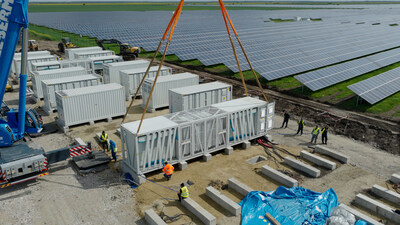
Located in Izvoarele, Giurgiu County, the project is being delivered for LSG and comprises a 40MW/160.48MWh utility-scale energy storage system scheduled for commissioning in Q3 2026.
The project integrates 32 units of Trina Storage's Elementa 2 Pro battery storage system together with four Electra AC units, marking the first deployment in Europe of Trina Storage's Elementa + Electra integrated DC+AC solution architecture. The deployment also represents a further step in Trina Storage's continued expansion toward more integrated cell-to-AC storage solution capabilities.
Elementa 2 Pro is Trina Storage's vertically integrated utility-scale liquid-cooled energy storage system built with 314Ah cells and a container-level capacity of 5.015MWh, designed to support high energy density and efficient deployment. Electra integrates the battery system with an AC-side unit combining power conversion and medium-voltage step-up functions, enabling more coordinated DC and AC system performance and streamlined grid connection for utility-scale energy storage applications.
Designed to support ancillary services, wholesale market arbitrage, load balancing, and renewable energy integration, the project is expected to contribute to increased grid flexibility and support Romania's accelerating renewable energy transition.
As renewable energy deployment continues to expand across Romania and Southeast Europe, demand for grid-balancing infrastructure and flexible storage capacity is increasing significantly. Utility-scale battery storage is expected to play a critical role in supporting grid stability, renewable integration, and electricity market optimization across the region.
The project also demonstrates Trina Storage's growing delivery and execution capabilities across complex European project environments, including multi-country logistics coordination, local compliance procedures, and integrated project support.
"The successful delivery of the Gamma project represents another important milestone for Trina Storage in Europe," said Gabriele Buccini, Head of Trina Storage Europe. "As energy storage markets continue to expand across Europe, we are seeing growing demand for integrated Cell-to-AC and bankable storage solutions capable of supporting long-term grid flexibility and renewable integration."
"LSG selected Trina Storage for this landmark project as part of its broader commitment to advancing reliable and future-oriented energy infrastructure in the region," said Gerhard Lipkovich, CEO of LSG Building Solutions SLR, Romania. "The collaboration will help support renewable energy integration while contributing to greater grid resilience and long-term energy transition objectives."
The Gamma project further strengthens Trina Storage's global energy storage presence and highlights the growing role of integrated storage solutions in supporting grid flexibility, renewable integration, and the evolving needs of modern power systems worldwide.
Photo - https://mma.prnewswire.com/media/2990219/Gamma_Elementa_Electra_Trina_Storage_LSG.jpg
 View original content:https://www.prnewswire.co.uk/news-releases/trina-storage-completes-delivery-of-first-elementa--electra-integrated-energy-storage-project-in-europe-302785499.html