JCET Releases 2025 Annual Report, Posts Record-High Full-Year Revenue and Higher Profit Before Tax
SHANGHAI, April 9, 2026 /PRNewswire/ -- Today, JCET Group (SSE: 600584), a leading global provider of integrated circuit (IC) back-end manufacturing and technology services, released its 2025 Annual Report. JCET reported record full-year revenue of RMB 38.87 billion in 2025, up 8.1% year-on-year. Profit before tax (PBT) totaled RMB 1.74 billion, up 5.4% year-on-year, and net profit attributable to shareholders reached RMB 1.57 billion.
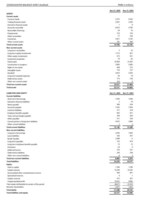
In the fourth quarter of 2025, revenue was RMB 10.2 billion, up 1.4% quarter-on-quarter. Net profit attributable to shareholders for the quarter was RMB 610 million, representing a 26.6% increase from the previous quarter.
In 2025, JCET maintained a steady and progressive operating approach, delivering another record-high annual revenue and achieving its third consecutive year of revenue growth since 2023. During the reporting period, the company's operations across both domestic and overseas sites remained stable, with capacity utilization staying at a high level. Advanced packaging capacity, including wafer-level packaging, continued to run at high load. Revenue associated with advanced packaging reached RMB 27 billion, marking a new high. JCET further increased investment in high-end advanced packaging technologies and capacity build-out, which, together with fluctuations in certain raw material prices, led to temporary cost pressures. However, as higher value-added businesses scaled and high-end capacity came on-stream, the company's profitability improved quarter by quarter through the year. Looking ahead, JCET will continue to assess market demand and maintain forward-looking investments in frontier technologies and critical capacity build-out, further strengthening its competitiveness over the mid to long term.
From an application perspective, JCET deepened its presence in high-growth segments including high-performance computing, storage, automotive electronics, and power management. The company advanced the introduction and mass production of new products in areas such as co-packaged optics (CPO), vertical power delivery modules, and intelligent driving. In 2025, revenue from the computing electronics, industrial and medical electronics, and automotive electronics segments increased 42.6%, 40.6% and 31.7% respectively year-on-year. During the year, JCET completed production line readiness at JCET Automotive (Shanghai) Co., Ltd., supporting automotive-grade and robotics applications. Meanwhile, JCET Microelectronics (Jiangyin) Co., Ltd. accelerated its capacity ramp to support high-end intelligent application demand.
In R&D, JCET drove systematic breakthroughs in critical advanced packaging technologies while further strengthening collaborative innovation across the industry chain. Total R&D expenses for 2025 reached RMB 2.09 billion, up 21.4% year-on-year. The company will further increase R&D investment in key technology areas, including high-density multi-dimensional heterogeneous integration, advanced bonding and interconnect technologies, and glass substrates, while accelerating the translation of R&D achievements into scalable manufacturing and commercial applications. To promote an open and collaborative advanced packaging ecosystem, JCET successfully hosted the Advanced Packaging Developers Conference (APDC) in Singapore, establishing a platform for technology exchange and joint innovation to speed implementation.
Mr. Li Zheng, CEO of JCET Group, said, "Over the past year, amid a shifting demand mix and cost volatility, JCET remained focused on application-led upgrades in advanced packaging and continued to steadily improve the quality of its operations. In 2026, JCET will capitalize on growth opportunities in high-performance computing, storage, and embodied intelligence, speeding the translation of technology breakthroughs into mass-production capability and incremental revenue. We will also further raise utilization and operating efficiency in our high-end capacity to strengthen the core competitiveness that supports long-term growth."
For more information, please refer to the JCET FY2025 Report
About JCET Group
JCET Group is a global leader in integrated circuit back-end manufacturing and technology services. We provide comprehensive turnkey solutions, including semiconductor package integration design, wafer probing, bumping, assembly, final testing, and global drop shipments.
Utilizing advanced wafer-level packaging, 2.5D/3D packaging, System-in-Package solutions, and reliable flip chip and wire bonding technologies, we support a wide range of applications, including automotive, artificial intelligence, high-performance computing, storage, communication, smart devices, industrial and medical sectors, and power and energy. With eight manufacturing facilities across China, Korea, and Singapore, we deliver efficient supply chain solutions and maintain close collaboration with our global customers.

PDF - https://mma.prnewswire.com/media/2953275/JCET.pdf
Logo - https://mma.prnewswire.com/media/2668674/5908784/JCET_Logo.jpg
 View original content to download multimedia:https://www.prnewswire.co.uk/news-releases/jcet-releases-2025-annual-report-posts-record-high-full-year-revenue-and-higher-profit-before-tax-302738504.html