2026 Kia CEO Investor Day: Kia to Drive Exponential Growth and Manufacturing Innovation by Expanding Its Full Electrified Vehicle Lineup and Strengthening Future Business Capabilities

09.04.2026
  • Kia presents its 2030 mid- to long-term strategy, detailing its vehicle- and region-specific exponential growth plans

  1. Targets global sales of 4.13 million units per year by 2030, with a global market share goal of 4.5%; targets sales of 3.35 million units in 2026
  2. Expands EV lineup to 14 models, aiming for 1 million annual EV sales by 2030
  3. Targets annual HEV sales of 1.1 million units through expanded lineup of 13 HEV models by 2030
  4. Sets a PBV sales target of 232,000 units by 2030, leveraging its full lineup of PV5, PV7, and PV9 models to strengthen its presence in the LCV market
  5. Accelerate exponential growth in key regions, with sales targets of 1.02 million units in the U.S., 746,000 units in Europe, and 1.48 million units in emerging markets
  • Kia reveals execution roadmap for SDVs, autonomous driving (AV), and robotics, accelerating its future business strategy
  1. Expand AV deployment, with completion of its first SDV model development by late 2027 and the rollout of urban AV (Level 2++) beginning in early 2029
  2. Advances manufacturing innovation with Atlas®, starting deployment at HMGMA in 2028, followed by expansion to Kia AutoLand Georgia in 2029
  • Plans to invest a total of KRW 49 trillion over the next five years (2026-2030), including KRW 21 trillion allocated to future businesses
  • Sets 2030 financial targets of KRW 170 trillion in revenue, a 10% operating profit margin, and KRW 17 trillion in operating profit
  • Kia President and CEO Ho Sung Song said, "EVs, HEVs, autonomous driving, and robotics will serve as key drivers for Kia's fastest growth to date"

SEOUL, South Korea, April 9, 2026 /PRNewswire/ -- Kia Corporation (Kia) today shared its mid-to-long-term business strategies and financial targets at its 2026 CEO Investor Day held in Seoul, Korea.
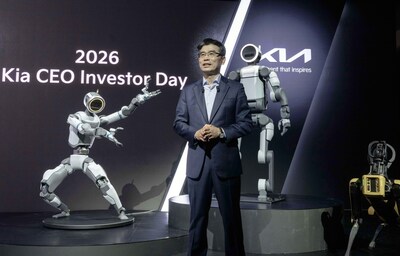
2026 Kia CEO Investor Day (PRNewsfoto/Kia Corporation)

This year's event focused on reviewing the five-year progress of Kia's 'Total Transformation' initiative, following the company's brand relaunch in 2021. Kia also outlined its mid- to long-term growth roadmap across all business sectors.

"Building on the achievements of innovation across all areas over the past five years —including brand, EVs, PBVs, and ESG — EVs, HEVs, autonomous driving, and robotics will serve as key drivers for Kia's fastest growth to date. Even amid the evolving global environment, Kia will proactively respond to changing market conditions through differentiated strategies." – Ho Sung Song, President and CEO of Kia Corporation. 

2030 Mid- to Long-Term Business Strategy

Kia aims to pursue a strategy to accelerate exponential growth, targeting global sales of 4.13 million units by 2030 with a 4.5 percent market share. This compares with a sales goal of 3.35 million units with a 3.8 percent market share in 2026.

Kia places customers at the centre of its business strategy and, over the mid- to long-term, the company intends to expand its mobility ecosystem with a strategic focus on PBVs, autonomous driving, and robotics, connecting people and infrastructure to drive enhanced value creation for both customers and wider society.

Overview of Key Announcements at Kia 2026 CEO Investor Day

Category

Content

2030

Mid- to

Long-

Term Business Strategy

Global Sales Targets

  • 2026 annual sales target: 3.35 million units; 3.8% market share
  • 2030 annual sales target: 4.13 million units; 4.5% market share


ICE & HEV

  • Launch 9 ICE models by 2030
  • Expand HEV lineup to 13 models by 2030
  • HEV sales target: 2026, 690,000 units → 2030, 1.1 million units (2030, 1.15 million xHEV units, including HEV/EREV/PHEVs)
  • Launch Body on Frame pickup truck with HEV, EREV variants by 2030


EV

Sales Target

  • 2030 annual sales target: 1 million units; 3.8% market share


Enhancing EV Product

Competitiveness

  • Establish lineup of 14 models
    • 2 passenger vehicles
    • 9 SUVs
    • 3 PBV models
  • Introduce next‑generation EV platform
  • Expansion of mass‑market EV lineup starting with EV2 in 2026


Improving EV Accessibility

  • Expand charging infrastructure with global charging partners
  • Strengthen charging networks in Korea (including Hyundai Motor Group's E-pit network), the U.S., and Europe


Strengthening

EV Supply Chain

  • Operate EV production hubs (EVO Plants in Korea)
  • Optimize regional production – Europe (EV2, EV4) and the U.S. (EV6, EV9)


PBV

  • 2030 annual sales target: 232,000 units (PV5, PV7, PV9)
  • Sequential launches of PV5 (2025), PV7 (2027), PV9 (2029)
  • Utilize Hwaseong EVO Plant as dedicated PBV production hub


Regional

Ex-growth

U.S.

  • 2030 annual sales target: 1.02 million units; 6.2% market share
  • HEV lineup expansion (4 → 8 models) & strengthen SUV volume models


Europe

  • 2030 annual sales target: 746,000 units; 4.8% market share
  • Introduce Kia's first SDV B-segment hatchback (B-HB) EV
  • Increase EV sales mix (2025 23% → 2030 66%)


Emerging

Markets

  • 2030 annual sales target: 1.48 million units; 6.6% market share
  • India targets 2030 annual sales of 410,000 units (market share 7.6%)


Future

Strategy

Autonomous Driving

  • Establish data-driven cycle of continuous improvement through NVIDIA partnership and strengthening in-house technology
  • Strategy ① Preemptive sensor and system‑level standardization through global partnerships to enable data scalability
  • Strategy ② Advancement of in‑house end‑to‑end (E2E) autonomous driving model capabilities based on 'Data Flywheel'
  • Complete development of Kia's first SDV model by the end of 2027, followed by introduction of Level 2++ autonomous driving technology in early 2029


Robotics

  • Develop last‑mile delivery solutions integrating robots with Kia PBVs (PV7, PV9)
  • Deploys Atlas at HMGMA starting in 2028 and Kia AutoLand Georgia in 2029

2026 Business Plan & 

Mid- to Long-Term Financial Targets

  • 2030 (KRW): Revenue 170 trn, OP 17 trn, OP Margin 10%
  • 5 Year Investment (2026~2030): KRW 49 trn

    (Future business Investment KRW 21 trn)
  • 2028 TSR target of over 35%, with continued enhancement of shareholder returns


For more information, visit the Kia Global Newsroom.
Photo - https://mma.prnewswire.com/media/2953023/Image_1__2026_Kia_CEO_Investor_Day.jpg

PDF - https://mma.prnewswire.com/media/2953024/Press_release__2026_Kia_CEO_Investor_Day.pdf


Cision View original content to download multimedia:https://www.prnewswire.co.uk/news-releases/2026-kia-ceo-investor-day-kia-to-drive-exponential-growth-and-manufacturing-innovation-by-expanding-its-full-electrified-vehicle-lineup-and-strengthening-future-business-capabilities-302738080.html

E10 günstiger, Diesel teurer: Deutscher Kraftstoffmarkt sendet gemischte Signale

09.04.2026

Der deutsche Kraftstoffmarkt sendet nach Wochen rasanter Anstiege widersprüchliche Signale: Während der Preis für Super E10 erstmals nach elf Erhöhungen in Folge leicht nachgibt, markiert Diesel weiter Rekordstände. Laut Daten des ADAC sank der bundesweite Tagesdurchschnittspreis für E10 auf 2,188 Euro je Liter und lag damit 0,4 Cent unter dem Vortag. Der Preis bleibt allerdings nur knapp unter dem Allzeithoch vom März 2022. Diesel verteuerte sich dagegen weiter und erreichte mit 2,447 Euro pro Liter einen neuen Höchstwert. An anderer Stelle wurden zur Mittagszeit sogar 2,471 Euro je Liter im Durchschnitt gemessen.

An den internationalen Märkten deuten sich dagegen Entspannungstendenzen an. Die Rohölpreise sind deutlich gefallen, nachdem Iran und die USA eine zweiwöchige Feuerpause im Konflikt im Nahen Osten angekündigt hatten. Nach Angaben des iranischen Außenministers Abbas Araghtschi soll während dieser Waffenruhe die strategisch wichtige Straße von Hormus geöffnet bleiben. Dennoch kommen die niedrigeren Notierungen bislang nur zögerlich an den deutschen Zapfsäulen an, obwohl die politischen Signale auf eine temporäre Beruhigung der Lage im Ölmarkt hindeuten.

In Deutschland spielt neben den globalen Faktoren auch die Marktstruktur eine Rolle. Das Bundeskartellamt verweist auf den sogenannten Rakete-und-Feder-Effekt: Steigende Kosten werden demnach schnell über höhere Preise an die Verbraucher weitergegeben, sinkende Kosten hingegen nur verzögert. Diese Beobachtung deckt sich mit der aktuellen Entwicklung. Zwar deuten die jüngsten Preisbewegungen laut ADAC darauf hin, dass der Höhepunkt überschritten sein könnte – die mittäglichen Preissprünge fielen zuletzt geringer aus als noch in der Vorwoche –, dennoch fordert der Verband, dass der gesunkene Ölpreis zügig an die Verbraucher weitergereicht wird.

Neue regulatorische Vorgaben könnten den Preisdruck zusätzlich beeinflussen. Seit Einführung einer 12-Uhr-Regel dürfen Tankstellen ihre Preise nur noch einmal täglich erhöhen, Preissenkungen sind dagegen jederzeit möglich. Am Mittwochmittag stiegen die Preise für E10 im Schnitt noch um 5,7 Cent, für Diesel um 5,3 Cent – der bislang niedrigste Anstieg seit Start der Regel. Gleichzeitig lagen die Durchschnittswerte um 12.15 Uhr unter denen des Vortages, bei E10 um knapp 3 Cent, bei Diesel um gut 3 Cent. Ökonomen wie die „Wirtschaftsweise“ Monika Schnitzer gehen davon aus, dass die niedrigeren Ölpreise in den kommenden Tagen weitergegeben werden, weisen jedoch darauf hin, dass die Preisanpassung typischerweise einige Zeit benötigt.

Ein Blick ins Ausland liefert Hinweise, wie stark eine mögliche Entlastung ausfallen könnte. In Frankreich rechnet der Vorsitzende der dortigen Ölindustrieunion, Olivier Gantois, bei einem stabilen Ölpreis von rund 93 bis 95 US-Dollar je Barrel mit einem Rückgang der Spritpreise um 5 bis 10 Cent pro Liter in den nächsten Tagen. Wie deutlich und wie schnell die deutschen Verbraucher profitieren, bleibt allerdings offen. Die Kombination aus geopolitischer Unsicherheit, strukturellen Marktmechanismen und regulatorischen Eingriffen sorgt dafür, dass der Weg von sinkenden Ölpreisen bis zur sichtbaren Entlastung an der Zapfsäule weiterhin lang und schwer kalkulierbar bleibt.